Exam Contract
- Equations and constants are furnished on the exam (syllabus).
- Definitions must be memorized (syllabus).
- Every exam mixes concepts with quantitative analysis (syllabus).
- Bring a nonprogrammable, nongraphing calculator (syllabus).
Source Aliases
| Alias | File path |
|---|---|
| HW1 | homeworks/HW 1 Summer 2026.pdf |
| Key HW1 | homeworks/Key HW 1 Summer 2026.pdf |
| UKEY-P5 | homeworks/hw-detailed/page5.png (unofficial Q3d print reference only) |
| syllabus | syllabus/2026 Summer BIS 103.pdf |
| course-map | docs/course-map.md |
| notes-08-03 | notes/course-intro-metabolism-overview-2026-08-03.md |
| notes-08-04 | notes/dna-microarrays-2d-gel-electrophoresis-2026-08-04.md |
| notes-08-05 | notes/microcalorimetry-and-glycolysis-intro-2026-08-05.md |
| notes-08-10 | notes/glycolysis-energetics-glycogen-2026-08-10.md |
| slides-L1 | slides/Lecture 1 BIS 103.pdf |
| slides-L2 | slides/Lecture 2 BIS 103 (key concepts from BIS 102).pdf |
| slides-L3 | slides/Lecture 3 BIS 103 (DNA microarrays 2D IEF SDS-PAGE).pdf |
| slides-L4 | slides/Lecture 4 BIS 103 (Microcalorimetry).pdf |
| slides-L5 | slides/Lecture 5 (Key Concepts in Metabolism; glycolysis).pdf |
| slides-L6 | slides/Lecture 6 (glycolysis cont.).pdf |
| slides-L7 | slides/Lecture 7 (delta G, delta Keg, and Beer's Law).pdf |
Inputs Manifest
- homework:
homeworks/HW 1 Summer 2026.pdf - key:
homeworks/Key HW 1 Summer 2026.pdf - unofficial-print-reference:
homeworks/hw-detailed/page5.png(Q3d conflict only; not answer authority) - notes-used:
notes/course-intro-metabolism-overview-2026-08-03.md-- Source transcript:transcripts/en-BIS-103_ 2026-08-03 12_07.txtnotes/dna-microarrays-2d-gel-electrophoresis-2026-08-04.md-- Source transcript:transcripts/en-BIS-103_ 2026-08-04 12_07.txtnotes/microcalorimetry-and-glycolysis-intro-2026-08-05.md-- Source transcript:transcripts/en-BIS-103_ 2026-08-05 12_07.txtnotes/glycolysis-energetics-glycogen-2026-08-10.md-- Source transcript:transcripts/en-BIS-103_ 2026-08-10 12_07.txt
- notes-unavailable: none (all four sessions in the MT1 range have current-contract notes)
- slides-used:
slides/Lecture 1 BIS 103.pdfslides/Lecture 2 BIS 103 (key concepts from BIS 102).pdfslides/Lecture 3 BIS 103 (DNA microarrays 2D IEF SDS-PAGE).pdfslides/Lecture 4 BIS 103 (Microcalorimetry).pdfslides/Lecture 5 (Key Concepts in Metabolism; glycolysis).pdfslides/Lecture 6 (glycolysis cont.).pdfslides/Lecture 7 (delta G, delta Keg, and Beer's Law).pdf
Tested-Topic Checklist
Directives (explicit "learn/know/be able to" instructions)
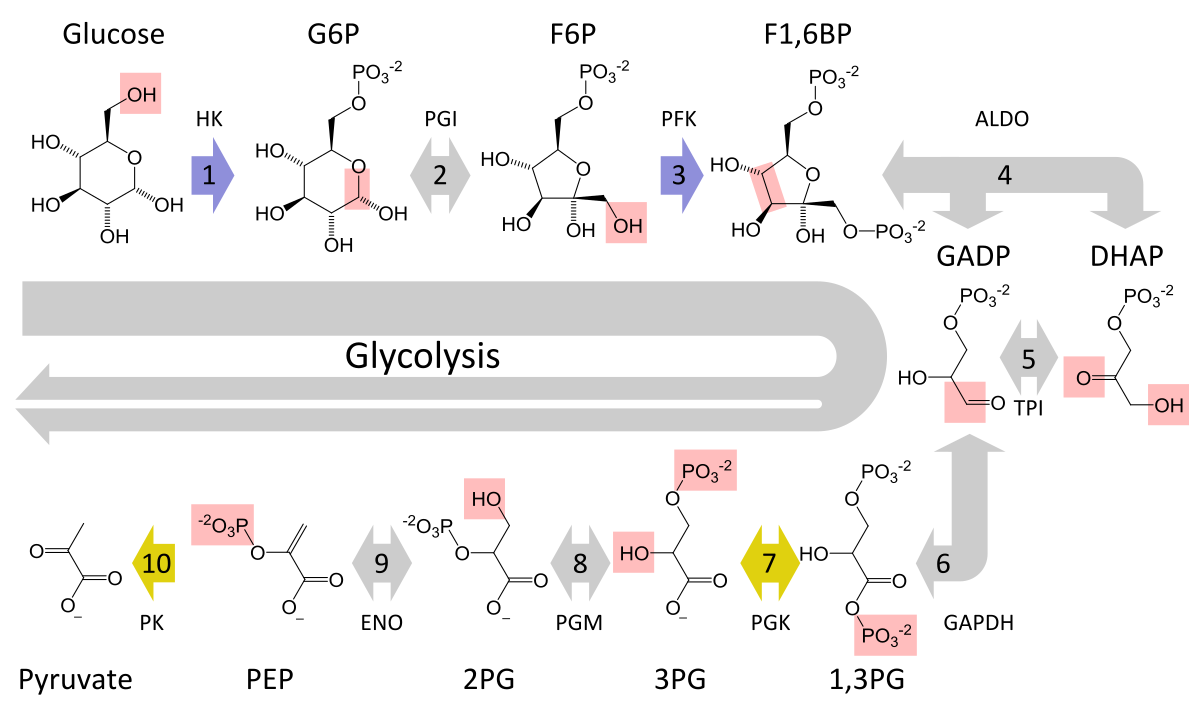
- Learn the structures of every intermediate in glycolysis and alcoholic fermentation (HW1 directive, p.1; diagram p.3)
- Learn the enzyme name for every step of glycolysis and alcoholic fermentation (HW1 directive, p.1)
- Learn the cofactor/coenzyme requirement for every step of glycolysis and alcoholic fermentation (HW1 directive, p.1)
- Learn the regulation of glycolysis and alcoholic fermentation (HW1 directive, p.1)
- Know which glycolytic and fermentation reactions are reversible and which are irreversible (HW1 directive, p.1)
- Be able to draw a triglyceride (triacylglycerol) with any of five fatty acids: 16:0, 18:0, 18:1(9), 18:2(9,12), 18:3(9,12,15) (HW1 directive, p.1)
- Be able to draw phosphatidylcholine with any of the five fatty acids (HW1 directive, p.1)
- Be able to draw phosphatidylserine with any of the five fatty acids (HW1 directive, p.1)
Segel Textbook Problems
- Weak acid/base calculations using Henderson-Hasselbalch (HW1 Segel #1: problems 29, 38(a,d,j), 40, 41)
- Beer's Law calculations (HW1 Segel #2: example 5-4, problem #4)
- K'eq and delta G calculations (HW1 Segel #3: examples 3-3, 3-4, 3-5)
Homework Questions
- DNA microarray experimental procedure and interpretation (HW1 Q1)
- Microcalorimetry: plotting heat rate vs. time for Parts A, B, C (HW1 Q2)
- Microcalorimetry: interpreting the effect of NaOH on CO2 trapping (HW1 Q2)
- Microcalorimetry: comparing control vs. pesticide-treated tissue (HW1 Q2)
- Microcalorimetry: drawing conclusions about metabolic effects (HW1 Q2)
- Enzyme kinetic graph: read the single-cuvette elapsed-time to A₃₄₀ trace, define its initial velocity from the initial slope, and contrast it with a multi-assay [S] to v₀ curve (HW1 Q3a; notes-08-10 section 19; notes-08-03 section 18)
- Interpreting the sign of delta-A/delta-time in a spectrophotometric assay (HW1 Q3b)
- Calculating IUs of enzyme from delta-A/delta-time using Beer's Law (HW1 Q3c)
- Evaluating pH change during an enzyme assay using Henderson-Hasselbalch (HW1 Q3d)
- Strategies to minimize pH change in an enzyme assay (HW1 Q3e)
- Preparing a Tris buffer at a specific pH from stock solutions (HW1 Q3f)
- Preparing a phosphate buffer at a specific pH from stock solutions (HW1 Q3g)
- Choosing between buffers for an enzyme assay (HW1 Q3g)
- Explaining why buffers are needed in enzyme assays (HW1 Q3h)
- Predicting banding patterns on IEF gels (HW1 Q3i)
- Predicting banding patterns on native PAGE gels (HW1 Q3i)
- Predicting banding patterns on SDS-PAGE gels (HW1 Q3i)
- Predicting banding patterns on 2D IEF/SDS-PAGE gels (HW1 Q3i)
- LDH isozyme composition and subunit MW calculations (HW1 Q3i)
Question-by-Question Drill Map
HW1 Directive -- Glycolysis and Alcoholic Fermentation (p.1, p.3)
Tests: Complete knowledge of glycolysis structures, enzymes, cofactors/coenzymes, regulation, and reversibility; alcoholic fermentation.
Covered in:
- notes-08-05 sections 21--29 (glycolysis steps 1--4: hexokinase through aldolase)
- notes-08-10 sections 1--11 (glycolysis steps 5--10: TPI through LDH; alcoholic fermentation)
- notes-08-10 section 13 (allosteric regulation of glycolytic enzymes: hexokinase, PFK1, pyruvate kinase)
- notes-08-03 section 15 (pyruvate-to-lactate reaction and NADH, introduced as BIS 102 review)
- Supplementary: slides-L5, slides-L6
Self-grading: Key HW1 p.4 (glycolysis and alcoholic fermentation diagram, same as HW1 p.3)

HW1 Directive -- Lipid Structures (p.1)
Tests: Drawing triglycerides, phosphatidylcholine, and phosphatidylserine with specified fatty acids (16:0, 18:0, 18:1(9), 18:2(9,12), 18:3(9,12,15)).
Covered in:
- notes-08-04 section 6 (fatty acid structures, nomenclature, cis double bonds)
- notes-08-04 section 7 (acylglycerols / triglycerides, L-glycerol, ester bonds)
- notes-08-04 section 8 (phospholipids: phosphatidylcholine and phosphatidylserine, phosphodiester bonds, quaternary amine)
- Supplementary: slides-L2
Self-grading: Key HW1 p.1 (directive restated; no separate worked drawing is provided -- drill from notes and slides)
HW1 Segel #1 -- Weak Acids/Bases (p.1)
Tests: Henderson-Hasselbalch calculations for buffering problems, including adding strong acid/base to a buffer system (problems 29, 38, 40, 41).
Covered in:
- notes-08-03 section 14 (Henderson-Hasselbalch equation, effective buffer requirements, proton addition)
- notes-08-03 section 16 (buffer preparation problem: phosphate buffer at pH 6.8 -- full worked example)
- notes-08-03 section 17 (Tris buffer chemistry)
- Supplementary: slides-L2
Self-grading: Key HW1 p.1 (comments on Segel problems 1--3)
HW1 Segel #2 -- Beer's Law (p.1)
Tests: Applying A = epsilon x L x C to calculate concentrations and absorbance in spectrophotometric assays.
Covered in:
- notes-08-10 section 17 (Beer's Law derivation, units, linearity, proportionality to concentration)
- notes-08-10 section 18 (alternative Beer's Law with specific absorbance)
- notes-08-10 section 19 (LDH assay using Beer's Law at 340 nm)
- Supplementary: slides-L7
Self-grading: Key HW1 p.1 (comments on Segel problems 1--3)
HW1 Segel #3 -- K'eq and Delta G (p.1)
Tests: Relating equilibrium constants to standard free energy changes; computing delta G from K'eq and vice versa.
Covered in:
- notes-08-10 sections 15--16 (equilibrium constant, delta G, delta G prime, delta G naught, reversing/adding reactions)
- notes-08-05 section 2 (Gibbs free energy equation: delta G = delta H - T delta S)
- notes-08-03 section 7 (delta G as free energy available to a cell, delta G prime for glucose and ATP)
- Supplementary: slides-L7
Self-grading: Key HW1 p.1 (comments on Segel problems 1--3)
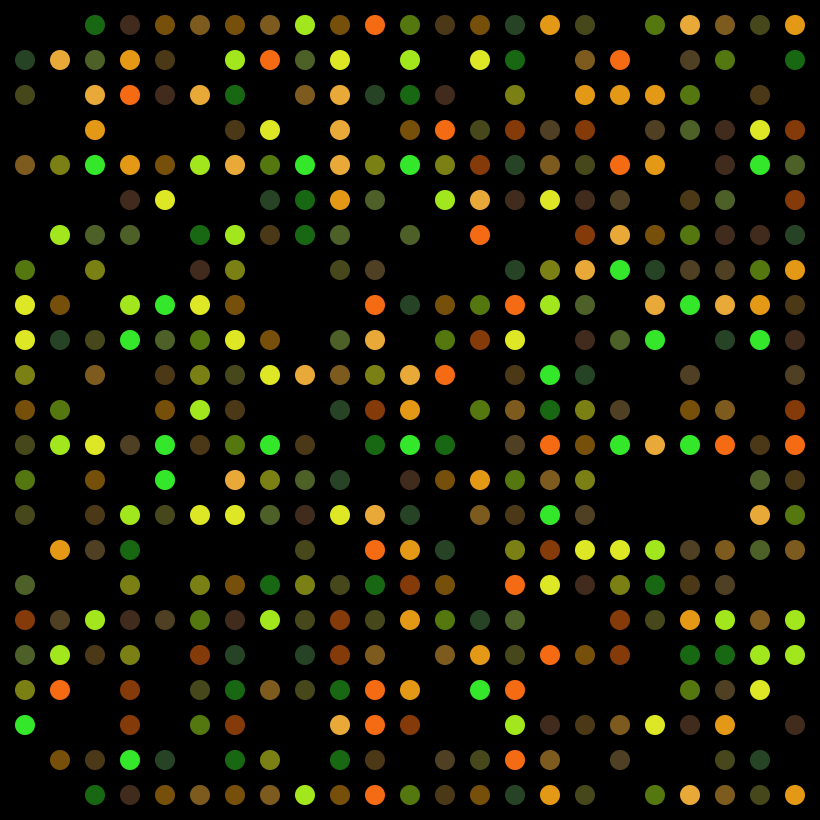
HW1 Q1 -- DNA Microarray Lab Exercise (p.1)
Tests: Understanding the laboratory steps of a DNA microarray experiment and interpreting results.
Covered in:
- notes-08-04 sections 9--16 (full DNA microarray procedure: mRNA isolation via oligo-dT affinity column, cDNA synthesis, fluorescent labeling, mRNA destruction, hybridization, scanning, color interpretation)
- notes-08-03 section 12 (introductory overview of DNA microarrays)
- Supplementary: slides-L3
Self-grading: Key HW1 p.1 (Q1 restated; the interactive exercise is self-checking)

HW1 Q2 -- Microcalorimetry Experiment (p.1)
Tests: Plotting microcalorimetry data (heat rate vs. time), interpreting Parts A/B/C, comparing control vs. pesticide-treated tissue, and drawing metabolic conclusions.
Covered in:
- notes-08-05 sections 2--12 (full microcalorimetry protocol: instrument setup, Part A baseline, Part B CO2 trap with NaOH, Part C control, dry weight, oxygen measurement, and summary)
- notes-08-05 section 13 (application: predicting growth from metabolic measurements)
- Supplementary: slides-L4
Self-grading: Key HW1 p.2 (Q2)
HW1 Q3a -- Enzyme Kinetic Graph Axes (p.2)
Tests: Reading Q3a in the context of the single mixed cuvette described immediately before it: label elapsed time and A₃₄₀ on the assay trace, identify the initial linear slope used for the assay's initial velocity, and distinguish that trace from a multi-assay substrate-concentration curve (HW1 Q3a; notes-08-10 section 19; notes-08-03 section 18).
Covered in:
- notes-08-10 section 19 (one-cuvette LDH assay: A₃₄₀ measured over elapsed time; the initial linear ΔA₃₄₀/Δtime region supplies the assay rate)
- notes-08-03 section 18 (explicit contrast: separate assays at different [S] values each supply one initial velocity, v₀, for a [S]-versus-v₀ Michaelis--Menten curve)
- notes-08-10 section 11 (Michaelis--Menten and allosteric enzyme review)
Drill: Sketch and label the one-cuvette trace first. Define "initial velocity" there as the initial linear ΔA₃₄₀/Δtime slope (or its magnitude when reporting activity). Then sketch the contrast graph and define each plotted v₀ as the initial rate derived from a separate assay run at one [S] (HW1 Q3a; notes-08-10 section 19; notes-08-03 section 18).
Self-grading: The official key gives no Q3a answer beyond directing the student to the notes. Use the two cited note sections to check the distinction; do not attribute either graph interpretation to the key (Key HW1 p.2, Q3a).
HW1 Q3b -- Interpreting Negative Delta-A (p.2)
Tests: Interpreting the sign of delta-A340/delta-time in the stated LDH assay.
Covered in:
- notes-08-10 section 19 (LDH spectrophotometric assay at 340 nm)
Self-grading: Key HW1 p.2 (Q3b)
HW1 Q3c -- IU Calculation (p.2)
Tests: Calculating International Units of LDH from delta-A340/delta-time using Beer's Law and the molar extinction coefficient of NADH.
Covered in:
- notes-08-10 section 20 (step-by-step IU calculation for LDH, including unit conversions from moles to micromoles)
- notes-08-10 section 17 (Beer's Law: A = epsilon x L x C)
- notes-08-10 section 12 (NAD spectral properties: epsilon-NADH at 340 nm = 6,220 M-1 cm-1)
Self-grading: Key HW1 p.2 (Q3c)
HW1 Q3d -- pH Change During Assay (p.2)
Tests: Using two Henderson-Hasselbalch equations to evaluate whether the buffer's pH changes during the assay, given the amount of H⁺ consumed by the forward LDH reaction and the buffer's pKa and molarity (HW1 Q3d; notes-08-03 sections 14--15).
Covered in:
- notes-08-03 section 14 (Henderson-Hasselbalch: pH = pKa + log([B]/[A]); what happens when protons are added)
- notes-08-03 section 16 (buffer preparation worked example with Henderson-Hasselbalch)
Self-grading: Key HW1 p.2 (Q3d)
HW1 Q3e -- Minimizing pH Change (p.2)
Tests: Three strategies to reduce pH change in an enzyme assay.
Covered in:
- notes-08-03 section 14 (effective buffer requirements: high molarity, pKa near desired pH, appropriate base-to-acid ratio)
Self-grading: Key HW1 p.2 (Q3e)
HW1 Q3f -- Tris Buffer Preparation (p.2)
Tests: Calculating volumes of stock Tris (pH 9), HCl, and water to prepare 500 mL of 200 mM Tris buffer at pH 7.3.
Covered in:
- notes-08-03 section 17 (Tris: structure, pKa ~8.2, acid form +1 charge, base form neutral; preparation by adding HCl to Tris base)
- notes-08-03 section 16 (general buffer preparation procedure using Henderson-Hasselbalch)
Self-grading: Key HW1 p.2 (Q3f)
HW1 Q3g -- Phosphate Buffer Preparation and Buffer Choice (p.2)
Tests: Calculating volumes of H3PO4, NaOH, and water to prepare 500 mL of 200 mM phosphate buffer at pH 7.3 (using pKa values 2.12, 7.21, 12.32); deciding whether to use Tris or phosphate for LDH assays.
Covered in:
- notes-08-03 section 16 (phosphate buffer preparation worked example using Henderson-Hasselbalch; polyprotic species)
- notes-08-03 section 17 (why phosphate can interfere with enzymes; man-made buffers preferred)
- notes-08-04 section 8 (phosphodiester bonds in biology -- context for why phosphate may interfere)
Self-grading: Key HW1 p.2 (Q3g)
HW1 Q3h -- Why Buffers Are Needed (p.2)
Tests: Explaining why a buffer is required in an enzyme assay even when H+ is not a substrate or product.
Covered in:
- notes-08-03 section 14 (buffer rule: non-interfering buffer must be present; pH affects enzyme structure and substrate binding)
- notes-08-03 section 6 (course theme: weak bonds -- hydrogen bonds and ionic bonds central to protein structure and substrate recognition)
Self-grading: Key HW1 p.3 (Q3h)
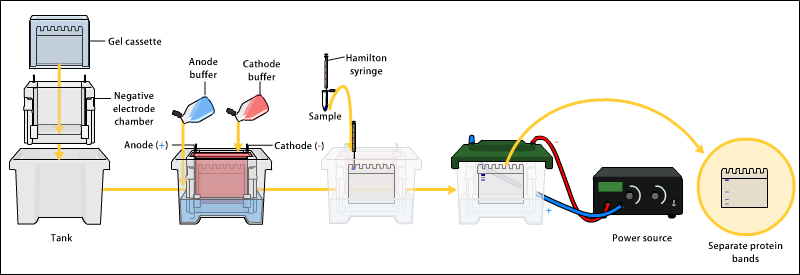
HW1 Q3i -- LDH Isozyme Gel Patterns (p.2)
Tests: Predicting banding patterns for bovine LDH isozymes (M4, M3H, M2H2, MH3, H4) from the prompt's native MW, four-equal-subunit description, and M/H pI values on: (a) IEF gel, (b) native PAGE gel, (c) SDS-PAGE gel, and (d) 2D IEF/SDS-PAGE gel. Must label bands with names, MWs, and electrodes.
Covered in:
- notes-08-04 section 3 (IEF gels: separate by PI, all structure levels intact)
- notes-08-04 section 4 (native PAGE: separate by size and charge-to-mass ratio, all structure intact; LDH mentioned as a four-subunit enzyme)
- notes-08-04 section 5 (SDS-PAGE: separate by size only, only primary structure remains, SDS charge-to-mass equalization)
- notes-08-04 sections 17--22 (2D IEF/SDS-PAGE: full procedure, interpretation, electrode placement)
- Supplementary: slides-L3
Self-grading: Key HW1 p.3 (Q3i)

Coverage Status and Gaps
Coverage is reported separately by dimension. A mapped concept does not erase a missing source, a silent key, an absent worked example, or incomplete visual support.
1. Source Availability -- partial
- Available: HW1, its official key, all four current-contract notes in the MT1 session range, and the mapped slide decks are present (HW1; Key HW1; course-map; notes-08-03; notes-08-04; notes-08-05; notes-08-10; slides-L1; slides-L2; slides-L3; slides-L4; slides-L5; slides-L6; slides-L7).
- Missing: The assigned Segel pages are not present in the repository: pp.92--93 for weak acids/bases, pp.332 and 352 for Beer's Law, and pp.161--164 for K'eq and delta G (HW1, p.1). The notes and slides map the underlying course concepts, but they do not reconstruct the unavailable exercise wording or data (notes-08-03 sections 14--17; notes-08-10 sections 15--20; slides-L2; slides-L7).
2. Factual Mapping -- complete
The bounded factual-mapping audit covers every tested topic group, while leaving the Segel source-availability gap above intact.
- Glycolysis, alcoholic fermentation, and lipid directives: mapped to notes-08-03 sections 15 and 18, notes-08-04 sections 6--8, notes-08-05 sections 21--29, notes-08-10 sections 1--13, slides-L2, slides-L5, and slides-L6 (HW1 directive, p.1).
- Segel concept groups: weak acids/bases map to notes-08-03 sections 14--17 and slides-L2; Beer's Law maps to notes-08-10 sections 17--20 and slides-L7; K'eq and delta G map to notes-08-03 section 7, notes-08-05 section 2, notes-08-10 sections 15--16, and slides-L7 (HW1 Segel #1--#3).
- Q1 and Q2: mapped to the DNA-microarray and microcalorimetry sections listed in their drill entries, with slides-L3 and slides-L4 as supplementary coverage (HW1 Q1--Q2).
- Q3a--Q3h: mapped to enzyme kinetics, LDH assay, Beer's Law, and buffer sections in notes-08-03 and notes-08-10 (HW1 Q3a--Q3h).
- Q3i: mapped to the IEF, native PAGE, SDS-PAGE, and 2D IEF/SDS-PAGE sections in notes-08-04, with slides-L3 as supplementary coverage (HW1 Q3i).
3. Task Completeness -- complete
All eight explicit homework directives, all three Segel assignment groups, Q1, Q2, and every subpart Q3a--Q3i have a checklist item and a question-level study task above (HW1, pp.1--2). This status covers task mapping only; it does not claim that every assigned source, worked solution, or visual is available.
4. Worked Coverage -- partial
- Available for consultation: The official key supplies self-grading locations for Q2 and Q3b--Q3i and a glycolysis/fermentation reference diagram; this prep document points to those locations without reproducing their answers (Key HW1, pp.2--4).
- Partial or missing: Q1 is restated rather than worked, Q3a has no keyed answer, the lipid directive has no separate worked drawing, and the assigned Segel exercise pages are unavailable (Key HW1, pp.1--2; HW1, p.1). Use the mapped notes and slides to practice these topics, but do not treat that fallback as replacement answer authority.
5. Visual Coverage -- partial
This prep route includes reference visuals for the glycolysis pathway, DNA-microarray workflow, and SDS-PAGE separation. It does not embed a complete visual drill set for the lipid structures, Q2 microcalorimetry traces, the Q3a assay trace and contrast curve, or all four Q3i gel formats. Use the official homework diagram and the mapped slide decks as the permitted visual fallbacks (HW1 directive and Q3i; slides-L2; slides-L3; slides-L4; slides-L5; slides-L6).
6. Unresolved Conflicts -- partial
- Q3a silent key: The official key gives no axis answer and says only to refer to the notes. For this drill, read the surrounding one-cuvette assay as an elapsed-time-to-A₃₄₀ trace; reserve [S]-to-v₀ for the explicit multi-assay Michaelis--Menten contrast. "Initial velocity" means the initial linear ΔA₃₄₀/Δtime slope in the first context and the initial rate contributed by each separate assay in the second. This adjudication is supported by the assay prompt and notes and is not attributed to the key (HW1 Q3a; Key HW1 p.2, Q3a; notes-08-10 section 19; notes-08-03 section 18).
- Q3d unofficial print: The unofficial page-5 image prints
7.305. That image is not answer authority and must not be used for self-grading; consult the official key location and the cited buffer notes instead (UKEY-P5; Key HW1 p.2, Q3d; notes-08-03 sections 14--15).
Definitions to Memorize
The exam furnishes equations and constants but requires definitions from memory (syllabus). The following definitions appear in HW1 and the lecture notes for sessions 1--4:
- Intermediary metabolism (notes-08-05 section 14)
- Assay (notes-08-03 section 9)
- Catabolic reaction / anabolic reaction (notes-08-05 section 14)
- Coupled reaction (notes-08-05 section 18)
- Coenzyme vs. cofactor (notes-08-10 section 10; notes-08-05 section 22)
- Dehydrogenase / kinase / mutase (notes-08-10 sections 3, 5, 6)
- Michaelis-Menten enzyme (notes-08-03 section 18)
- Allosteric enzyme (notes-08-03 section 18; notes-08-10 section 13)
- Vmax, Km, KI (notes-08-03 section 9)
- Turnover number (notes-08-03 section 9)
- International Unit (IU) (notes-08-10 section 20)
- PI (isoelectric point) (notes-08-04 section 3)
- IEF, native PAGE, SDS-PAGE (notes-08-04 sections 3--5)
- SDS (sodium dodecyl sulfate) (notes-08-04 section 5)
- Affinity chromatography (notes-08-04 section 2)
- Stacking gel / resolving gel (notes-08-04 section 4)
- DNA microarray (notes-08-04 section 9)
- cDNA / reverse transcriptase (notes-08-04 section 13)
- Poly-A tail (notes-08-04 section 9)
- Transcriptome / proteome (notes-08-03 section 12; notes-08-04 section 17)
- Saturated fatty acid / unsaturated fatty acid (notes-08-04 section 6)
- Acylglycerol / triacylglycerol (notes-08-04 section 7)
- Phospholipid / phosphodiester (notes-08-04 section 8)
- Quaternary amine (notes-08-04 section 8)
- Microcalorimetry (notes-08-05 section 2)
- Steady state vs. equilibrium (notes-08-05 section 2; notes-08-10 section 15)
- Acyl phosphate (notes-08-05 section 19; notes-08-10 section 3)
- Hydride (H-) (notes-08-03 section 15)
- NAD+ / NADH (notes-08-03 section 15; notes-08-10 section 12)
- Beer's Law -- A = epsilon x L x C (notes-08-10 section 17)
- Molar extinction coefficient (epsilon) (notes-08-10 section 17)
- Delta G prime (notes-08-10 section 4)
- PEP (phosphoenolpyruvate) (notes-08-10 section 7)
- Glycolysis (notes-08-05 section 21)
- Henderson-Hasselbalch equation (notes-08-03 section 14)
- Tris (notes-08-03 section 17)
- Pyruvate (notes-08-03 section 15)
- Acetyl-CoA (notes-08-05 section 15)
- Ampholytes (notes-08-04 section 18)
Quantitative Skills to Drill
| Skill pattern | HW question(s) |
|---|---|
| Henderson-Hasselbalch: compute pH after adding strong acid/base to a buffer | HW1 Q3d, Segel #1 (problems 29, 40, 41) |
| Henderson-Hasselbalch: determine [B]/[A] ratio at a given pH, then calculate volumes for buffer preparation | HW1 Q3f, Q3g, Segel #1 (problem 38) |
| Beer's Law: calculate concentration from absorbance (or vice versa) using epsilon | HW1 Q3c, Segel #2 |
| IU calculation: convert delta-A/delta-time to micromoles product per minute | HW1 Q3c |
| K'eq and delta G: compute delta G naught from K'eq (and vice versa); combine coupled reactions | Segel #3 (examples 3-3, 3-4, 3-5) |
| Microcalorimetry graphing: plot heat rate vs. time for Parts A/B/C, normalize to dry weight | HW1 Q2 |
| Gel electrophoresis prediction: determine number of bands, band positions, and MWs for IEF, native PAGE, SDS-PAGE, and 2D gels given subunit composition, pI, and MW | HW1 Q3i |
| Lipid structure drawing: construct triglycerides and phospholipids with specified fatty acids at correct positions, including ionization state at pH 7 | HW1 lipid directive |
| Dilution / mixing: calculate volumes when diluting stock solutions to target molarity and final volume | HW1 Q3f, Q3g |